Decoy Tricks
Copyright © 1998 - 2021 Roger
W. Raisch * Nadine Adele, all rights reserved
|
| Spring gobblers either love or hate decoys depending on
their mood and how the decoys are used. There are three key questions about decoy use: |
- How to hunt with them safely?
|
| The following SECRETS
will teach you how and when to use them safely while bow hunting. |
| The reason to use decoys is to draw a gobbler's attention
away from you and your Blind
and to entice him into close bow range (6-15 yards). Use decoys that look realistic and
ones that will stand up to hard use. Collapsible decoys, both a Hen and Jake are preferred by Master Turkey Hunters because they're quick
and easy to set up, lightweight, and are noiseless when carried. I'm convinced they are the reason I
bagged many gobblers with bow that I would not have gotten otherwise. |
| Despite the most realistic looking and acting decoys, your
experience with decoys will vary and there are a lot of tricks to keep in mind when using
any decoy, especially for bow hunters. I've watched gobblers carry
collapsible decoys away in their beaks! On the other hand, I've watched plenty of
gobblers retreat from both hen and male decoys, watched others fight hen decoys, watched
gobblers totally ignore a male decoy that was very close to a real hen or hen decoy, and
watched gobblers breed jake decoys. No decoy type or tactic will work every time. |
| You can and will have mixed results with decoys. I've
watched gobblers run the other direction when they first spotted a decoy. Younger gobblers
(jakes and two-year old adults) are often quite wary of a full strut decoy, jake decoy, or
a group of decoys because they have been dominated, spurred, chased and generally made to
feel not-wanted by older gobblers during the spring season. |
| Positioning a decoy is critical.
If it's too far away, say 25 yards, and a gobbler comes in on the far side, spies it at 25
yards, he may hang up. He'd then be way out of range at 50 yards and probably won't come
closer. For maximum effectiveness, place your decoy(s) no more than 6-10 yards away to
draw the gobbler into 10-20 yard range. |
| Being near a decoy can be dangerous
because other hunters may mistake your calling and the sight of a decoy for what they
think is a real turkey, causing them to take a shot in your direction. This is
particularly true when using a male decoy, or a movement decoy awhile staying in one
location for a considerable period of time in a blind. To protect yourself, set your blind
in an area with flat terrain where you can see in all directions. Place
your decoy(s) in one area in front of you, not on every side of your blind. Then,
the danger zone has been significantly reduced to the area in front of you which you can
watch. To further reduce danger, tie a small piece of blaze orange material to a decoy. If
another hunter approaches, signal him/her with a human voice, not with a turkey call or by
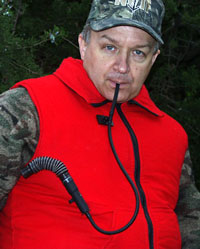
making a motion. To provide the most personal protection while using decoys, use a Ballistic Turkey Hunter Vest, which will repel a shotgun blast. |
| Some people claim that decoys with a portion of their body
painted blaze orange may provide a bit more protection. But turkeys see color very well.
Too much out-of-place color will usually cause a gobbler to retreat, especially too much
blaze orange when he's very close. Setting up properly with realistic-looking and acting
decoys will provide the best odds for success, keeping in mind the safety issues. |
| I suggest using more than one decoy.
During a recent spring, I was able to bag two gobblers with bow and arrow while using
more than one decoy. I feel that several decoys are best when bow hunting. |
DON'T USE DECOYS WHEN OTHERS MAY
BE NEAR OR IN HEAVILY-HUNTED PUBLIC AREAS!! The risk may be too high regardless
of the precautions you take. PLAY IT SAFE! Practice
Defensive Turkey Hunting to protect
yourself.
|
|
| |
t

God Bless America
|
View
Cart & Check-Out
JULY 2026
877.267.3877
515.299.5388
24 / 7
WE answer
our
phones Personally!
|
|
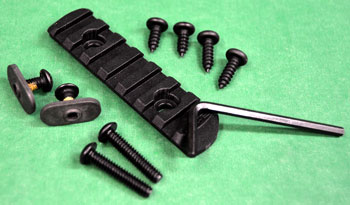 Picatinny
Rail Mounting Kit™ ...
Picatinny
Rail Mounting Kit™ ...
 The
Tracker Clips™
... Tie The Tracker Spool™ Line to Arrow
... Fast, Fast !
The
Tracker Clips™
... Tie The Tracker Spool™ Line to Arrow
... Fast, Fast !